An enterprise-grade financial literacy platform for IDFC FIRST Academy — built to educate diverse audiences at scale under stringent regulatory and compliance constraints. As VP of UX, I defined the experience vision and governance model, ensuring every decision reinforced trust, clarity, and learning effectiveness across products, teams, and vendors.

Educate diverse audiences without publishing in silos.
Financial literacy initiatives in large banks rarely fail on content — they fail on systemic patterns. The mandate was to design a learning system, not another content site.
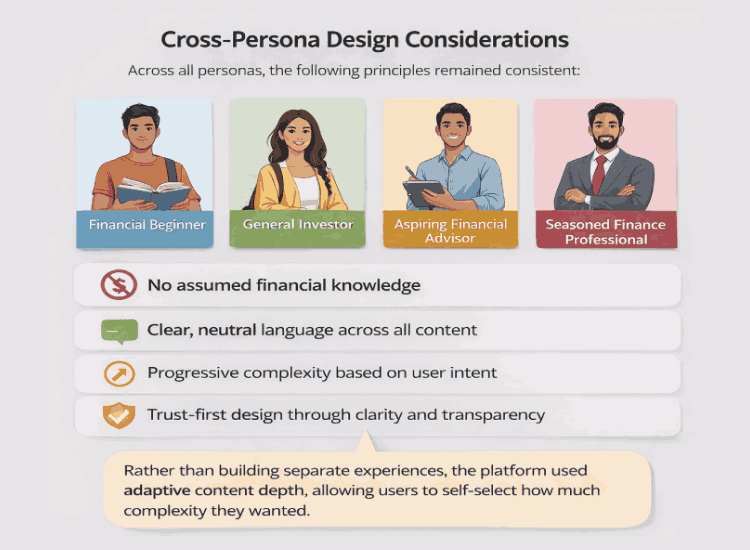
Research revealed that while user confidence levels differed widely, expectations around clarity, trust, and control were consistent across all personas — plain, neutral language significantly improved comprehension and reduced perceived risk.

Users had uneven financial knowledge and disengaged when assumptions were made or language became overly technical. They did not resist complexity; they resisted forced complexity — progressive disclosure driven by user intent measurably increased engagement and confidence.
Rather than building fragmented persona-based experiences, the platform adopted adaptive content depth — allowing users to choose how much detail they needed. This approach improved scalability, reduced cognitive load, and reinforced trust across all user groups.
"I want to start with the basics — but I don't want to feel talked down to."
"Just tell me what the rules are. Don't bury them in jargon."
"If I have to read three paragraphs to know what this means, I close the tab."
Financial education without governance is content debt at scale.
Content was published without designed learning journeys — users consumed but did not build understanding.
Ownership fragmented across marketing, compliance, product, and vendors — producing inconsistent experiences.
Regulatory disclosure crowded out comprehension — compliance read as risk-aversion, not service.
No reusable patterns — every new topic required redesigning the journey, slowing evolution and increasing rework.
I led the UX vision and execution across the platform — translating regulatory, educational, and operational requirements into a coherent, user-centric experience.
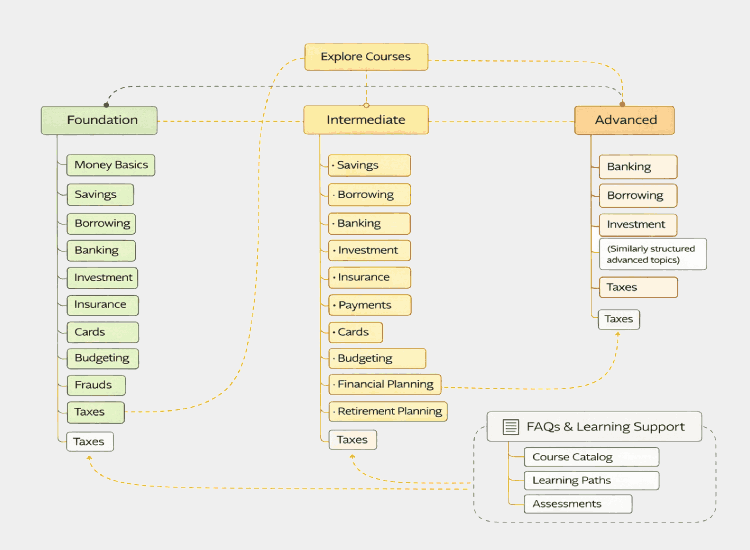
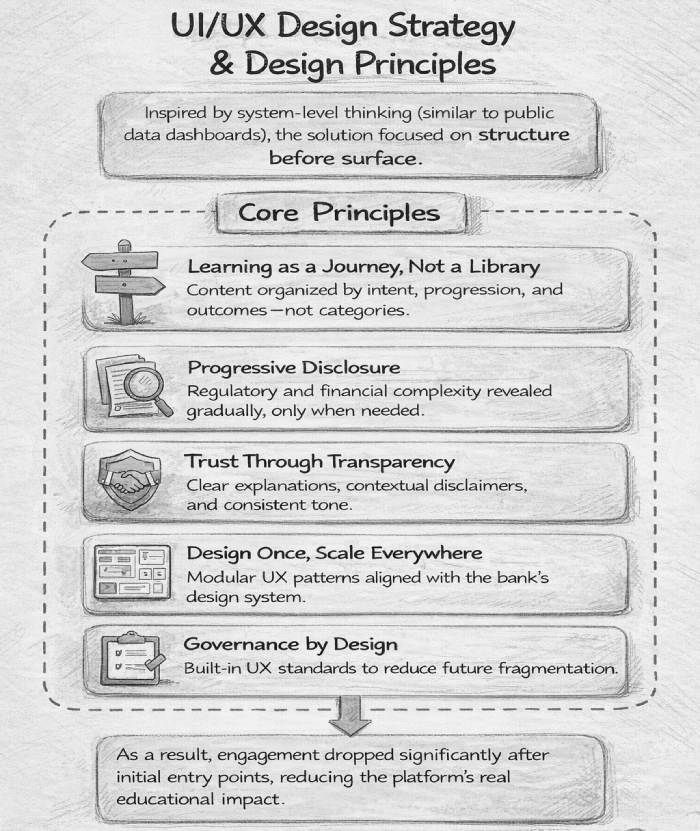
The platform was reframed as a learning ecosystem, not a content portal — with intent-based entry points, structured paths, standardized content templates, and unified interaction patterns. UX standards governed clarity, accessibility, and progression. Regulatory and policy requirements were translated into reusable design patterns, embedding compliance into the experience rather than treating it as a downstream check.
Users discover topics through intent-based entry points, progress through structured paths with visible milestones, and return as confidence compounds — measured engagement, not page views.

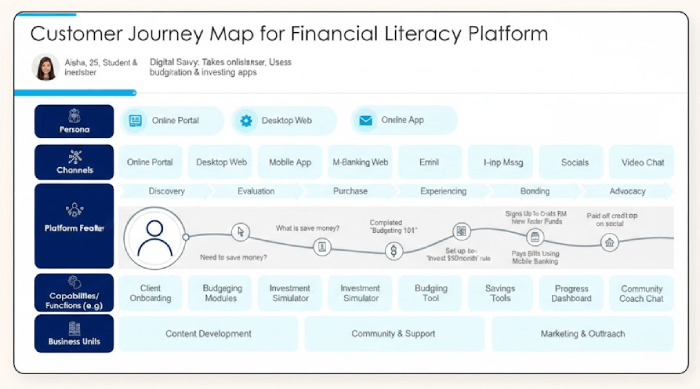
Every screen, template, and confirmation message was anchored to a mapped moment. Every sign-off verified that the moment had been designed for, not assumed. The journey map was the canonical reference through every design and vendor review.
Existing content, journeys, and analytics were audited to identify drop-off and comprehension gaps. The new architecture organized topics into intent-based entry points with progressive depth.

Every wireframe was traceable to a journey moment, and every IA decision was signed off before vendor execution. Storyboards were leveraged to align business, brand, talent acquisition, compliance, and vendor teams on what each moment had to feel like — before any pixels were committed.
Discovery · Learning path · Progress checkpoint — the three load-bearing surfaces of the academy
A modular design system aligned to the bank's tokens — standardized content templates, accessible typography, and reusable components that scaled across modules and programs without redesign.

Embed compliance into patterns, not paragraphs.
A centralized governance model maintained UX, accessibility, and regulatory standards while letting domain teams build independently within shared guardrails.
Core UX standards and risk controls were centrally maintained, while implementation remained flexible at the domain level. Governance was lightweight and embedded into delivery workflows, focusing on systemic risks — accessibility, regulatory compliance, brand integrity, apply-flow friction — rather than surface-level design. Continuous improvement was driven through analytics and shared learnings.
Iterative validation with internal users and stakeholders surfaced where instructional clarity needed work — content hierarchy and explanatory patterns were refined before rollout, not after.
Role pages restructured so candidates established relevance within seconds. Headline, signal-bearing tags, and growth indicators surfaced before scroll.
Filters and sorting logic refined to align with the criteria candidates actually used — not the criteria the platform exposed by default.
Content hierarchy and CTAs improved so candidates entered the apply flow knowing what to expect. Confirmation messaging validated to reassure on submit.
Insights translated into refinements before launch — reducing rework during vendor implementation and surfacing systemic issues that would have appeared only post-release.
The academy moved from publishing content to operating a learning system — credible, inclusive, and scalable, with UX as the strategic control point.

A regulated bank's financial literacy program became a governed learning ecosystem — design moved from publishing content to operating a system.
The academy shifted from a content portal to a long-term product system. Compliance, accessibility, brand, and learning effectiveness shared one governance layer. New topics and programs could be absorbed without renegotiating the foundations. UX held the pen on the principles that kept the experience coherent at scale.
Designing for financial literacy is a governance shift before it is a content exercise. These are the lessons I'd carry into any regulated education platform.

Financial literacy programs do not fail for lack of material — they fail because ownership is fragmented and progression is unstructured. Establishing UX as the governing layer turned isolated content into a coherent learning system.
Embedding regulatory requirements into reusable templates and components moved compliance from defensive paragraphs to a quiet, consistent property of the experience — strengthening trust rather than draining it.
Users at every knowledge level expect clarity, trust, and control. Adaptive content depth — letting users choose how much they need — outperformed persona-specific experiences and was easier to govern.
Treating the academy as a long-term product system rather than a launch milestone meant patterns, governance, and review checkpoints kept the experience consistent as topics, contributors, and programs evolved.