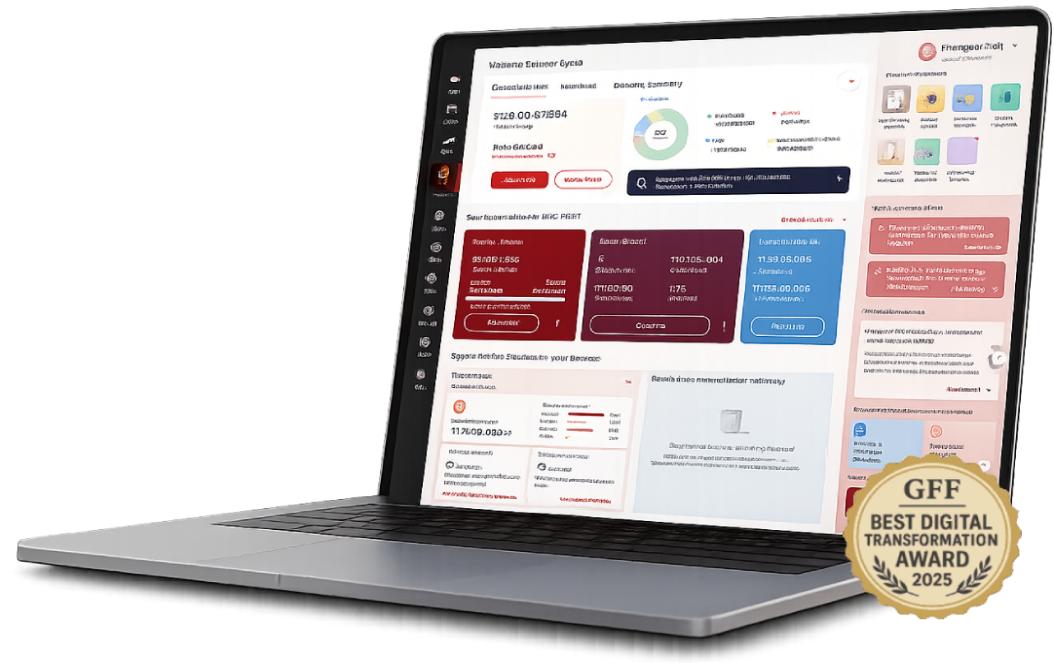
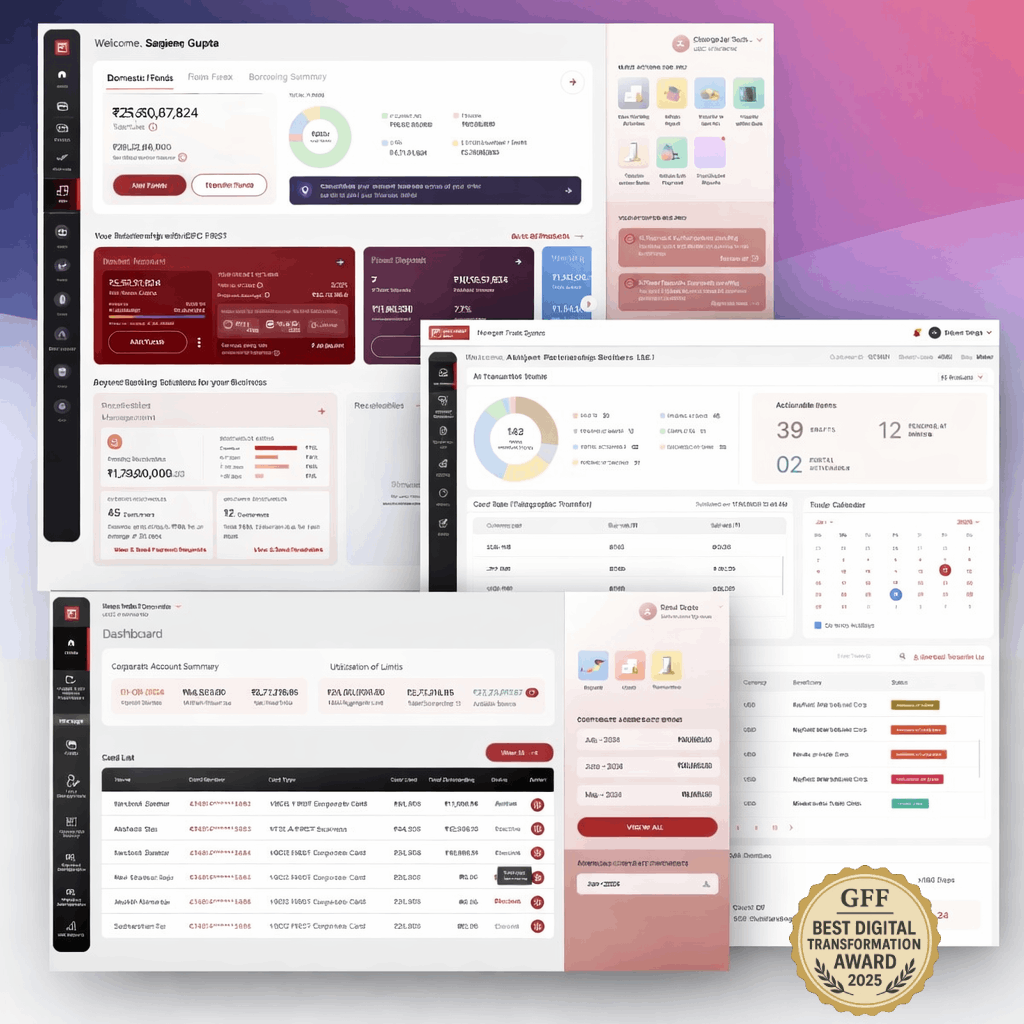
Leadership-level UX transformation of multiple mission-critical enterprise banking applications — focused on workflow clarity, consistency at scale, and UX governance rather than surface-level visual redesign. The mandate was to reduce operational friction, improve reliability, and ensure enterprise UX quality across teams, vendors, and platforms.

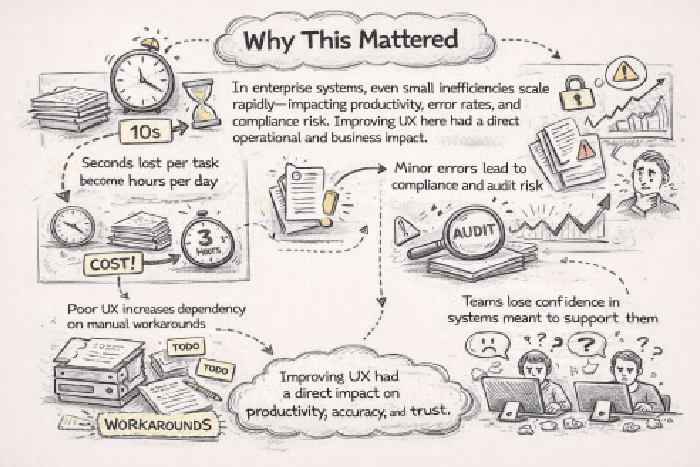
Small UX inefficiencies compound at enterprise scale.
Enterprise systems had evolved organically over years — individually they functioned; collectively they introduced inefficiency, risk, and usability debt. The challenge was not modernization, but rethinking how work actually happens inside the bank.
Research and operational reviews revealed that users were relying on memory, experience, and informal workarounds where systems should have provided clear guidance and structure — most visibly during handoffs and edge cases.

Screens were consistently organized around system features rather than real user tasks, increasing cognitive load and slowing execution. Inconsistent patterns across applications forced users to relearn behaviors each time they moved between tools, creating friction and avoidable errors.
The problem was systemic — requiring enterprise-level UX governance and shared standards rather than isolated, screen-by-screen fixes.
"Every system looks different. I rely on memory to do the same task in three places."
"If I miss a step here, it shows up in audit later. I need the system to tell me."
"Overrides are part of my day. I need to know it's safe and reversible before I commit."
Enterprise UX is a reliability discipline, not a branding exercise.
Workflows fragmented across applications, with inconsistent UI patterns from multiple vendors.
High cognitive load for routine, repeatable tasks — users compensating with memory and workarounds.
Heavy dependency on training and tribal knowledge to bridge gaps the system should have closed.
Edge cases and handoffs became failure points — small inefficiencies compounded into operational risk.
I owned direction, decision-making, governance, and final sign-off across the enterprise UX transformation — driving a shared vision across products, vendors, and operational teams.
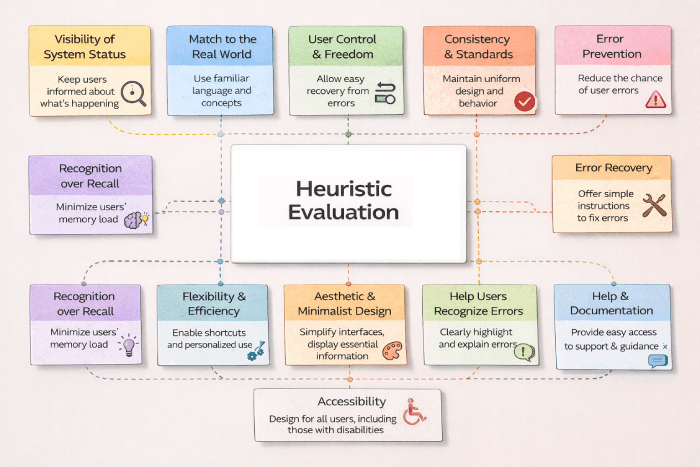
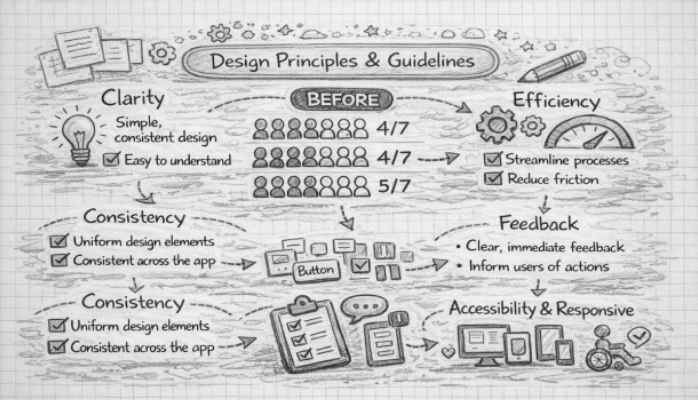
Five non-negotiable principles governed every decision: task over feature, reduce cognitive load, consistency builds trust, design for failure scenarios, and governance by default. These were used as review and sign-off criteria — not aspirations.
Operational journeys were mapped task-by-task — surfacing where users were carrying the system rather than the system carrying them. Every pattern decision traced back to a moment on this journey.

Every screen, template, and confirmation message was anchored to a mapped moment. Every sign-off verified that the moment had been designed for, not assumed. The journey map was the canonical reference through every design and vendor review.
Workflow analysis decomposed operational tasks into structural patterns. The pattern library translated those into reusable layouts that vendors could execute against.

Every wireframe was traceable to a journey moment, and every IA decision was signed off before vendor execution. Storyboards were leveraged to align business, brand, talent acquisition, compliance, and vendor teams on what each moment had to feel like — before any pixels were committed.
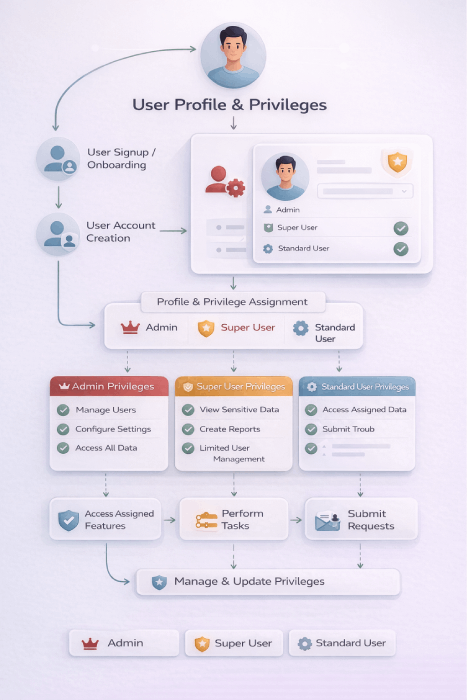
Privileged access · Workflow orchestration · Audit trail — pillars of the enterprise UX
A shared enterprise design system encoded layout rules, accessibility requirements, and interaction behavior — making consistency the default and reducing dependency on vendor interpretation.

Centralized standards. Vendor-proof execution.
UX standards lived inside delivery checklists and approvals — not on top of them — so quality, consistency, and risk reduction were enforced as the work happened, not after.
Core UX standards and risk controls were centrally maintained, while implementation remained flexible at the domain level. Governance was lightweight and embedded into delivery workflows, focusing on systemic risks — accessibility, regulatory compliance, brand integrity, apply-flow friction — rather than surface-level design. Continuous improvement was driven through analytics and shared learnings.
Redesigned workflows were tested with real users under realistic constraints — validating error prevention, recovery paths, and edge-case handling before scaling to additional applications.
Role pages restructured so candidates established relevance within seconds. Headline, signal-bearing tags, and growth indicators surfaced before scroll.
Filters and sorting logic refined to align with the criteria candidates actually used — not the criteria the platform exposed by default.
Content hierarchy and CTAs improved so candidates entered the apply flow knowing what to expect. Confirmation messaging validated to reassure on submit.
Insights translated into refinements before launch — reducing rework during vendor implementation and surfacing systemic issues that would have appeared only post-release.
The program established UX as a strategic capability — shifting enterprise design from isolated fixes to a governed, scalable system with clear accountability for quality and long-term experience health.

Disconnected applications became a cohesive enterprise UX system — design moved from screen-level fixes to governed patterns.
Beyond usability metrics, the program shifted enterprise design from isolated fixes to a governed, scalable system. Patterns, standards, and review checkpoints created clear accountability for quality and long-term experience health — making UX a defensible part of how the organization ships software, not a decorative final pass.
Great enterprise UX disappears — it enables people to focus on decisions, not interfaces, making systems reliable, predictable, and trusted.
The work that moved the needle was reducing memory load, enforcing consistency, and designing for failure scenarios — not visual modernization. Treating UX as a reliability discipline reframed every conversation with stakeholders.
Whenever screens were organized around system capabilities instead of operational tasks, cognitive load spiked and errors followed. Designing for how work actually happens — not how systems expose themselves — was the single highest-leverage decision.
Standardized layouts and interaction behaviors made consistency the default across vendor-led implementations. A shared pattern library turned out to be the most effective form of governance — quieter than reviews, harder to bypass.
Embedding standards into delivery processes and approvals meant quality was enforced as work happened. Reviews catch problems; defaults prevent them — and that distinction defined the program's long-term durability.