

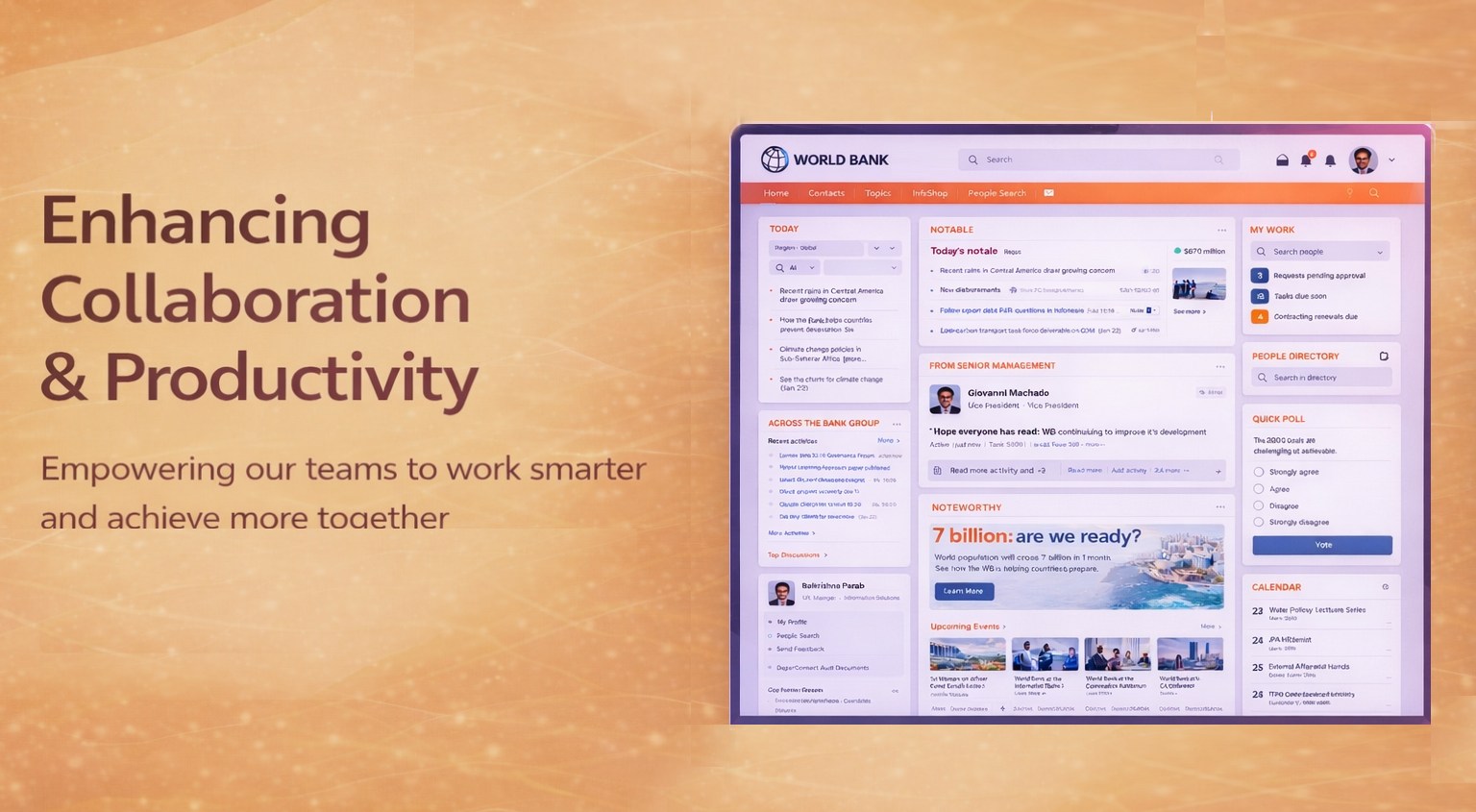
Client Overview
The World Bank Group is a leading multilateral organization in global economic development. Its Information Solutions Group (ISG) provides centralized IT services aligned with the Bank’s business strategy, supporting employees at headquarters and country offices. ISGIS is responsible for internet services infrastructure, enterprise portals, website standards, publishing platforms, and institutional data warehouses supporting business intelligence.
Due to growing usability challenges and scale, ISGIS engaged an external UXM team to establish a structured user experience capability through an offshore–onsite delivery model.
Business Need
- Managing UX across numerous websites and applications was becoming overwhelming
- Limited time for strategic improvements due to constant enhancements and fixes
- Need for specialized UX skills at optimized cost
- Faster turnaround with consistent, reusable UX artifacts
To address this, ISGIS adopted an offshore–onsite UXM model to support interaction design, wireframes, visual design, and production-ready HTML.
Business Objectives
- Reduce user memory load
- Ensure consistent and meaningful screen elements
- Align new features with familiar user patterns
- Deliver long-term, scalable solutions
- Improve efficiency, flexibility, and performance
- Enable fast loading even in low-bandwidth country offices
Design-Specific Goals
- Improve usability and findability
- Increase intranet adoption
- Add interactive widgets using modern technologies
- Improve performance using sprites and optimized code
- Create new UIs as required
PROBLEMS
I was working within a highly complex enterprise environment where managing user experience across numerous intranet websites and applications had become increasingly fragmented. UX work was largely reactive—driven by constant enhancements, urgent fixes, and operational requests—leaving little room for strategic experience planning or long-term standardization.
The lack of unified UX guidelines and reusable interaction patterns led to inconsistent interfaces, higher cognitive load for users, and inefficiencies across design and development teams. At the same time, there was a clear need for specialized UX capabilities that could scale efficiently while maintaining cost and delivery discipline.
MY ROLE
UX Management & Experience Architecture: I worked closely with ISGIS stakeholders as part of an offshore–onsite UXM model, contributing to the definition and execution of experience standards that translated usability principles into scalable, production-ready solutions.
Responsibilities
- Defining and applying UX standards and interaction guidelines across intranet applications
- Supporting information architecture, interaction design, and visual design efforts
- Creating and reviewing low-fidelity wireframes and high-fidelity HTML prototypes
- Ensuring consistency and usability across multiple enterprise web properties
- Driving reuse through standardized UI components and design patterns
- Supporting production-ready front-end delivery using HTML, CSS, and JavaScript
- Collaborating with cross-functional teams through structured work requests and design reviews
GOALS
My goal was to help establish a structured User Experience Management (UXM) model that could bring clarity, consistency, and scalability to the World Bank’s intranet ecosystem.
This initiative focused on:
- Creating consistent interaction patterns across portals and applications
- Reducing user effort through familiar and predictable UI behaviors
- Improving usability and performance, including for low-bandwidth country offices
- Improve performance using sprites and optimized code
- Enabling faster turnaround through reusable UX artifacts and standardized front-end practices
USER RESEARCH
I conducted user interviews with employees across headquarters and country offices, supplemented by empathy mapping, to understand how people navigate and use the World Bank’s intranet in their day-to-day work. Research revealed that users were not struggling due to lack of information, but due to how information was structured, presented, and accessed. The intranet contained a large volume of content, tools, and links, but users often found it difficult to identify what actions to take or where to begin.
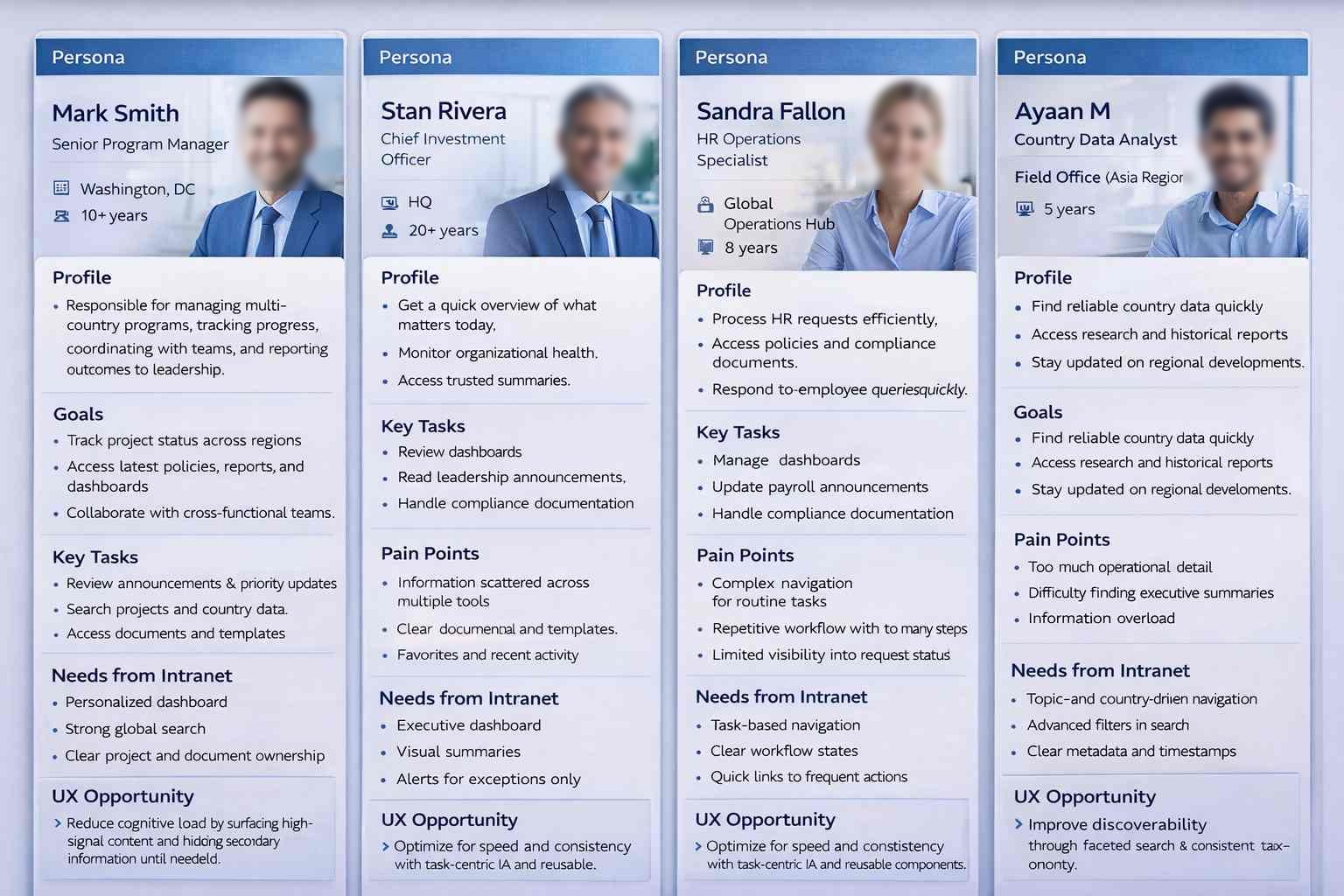
INFORMATION
Content was abundant but poorly prioritized, making it unclear where users should start or what action to take next.
INTERACTION
Inconsistent placement and behavior of UI elements increased cognitive load and slowed task completion across modules.
EXPERIENCE
The intranet felt fragmented and effortful, when users expected a single, predictable system that enabled confident action.
USER JOURNEY
I conducted user interviews with employees across headquarters and country offices, supplemented by empathy mapping, to understand how people navigate and use the World Bank’s intranet in their day-to-day work. Research revealed that users were not struggling due to lack of information, but due to how information was structured, presented, and accessed. The intranet contained a large volume of content, tools, and links, but users often found it difficult to identify what actions to take or where to begin.
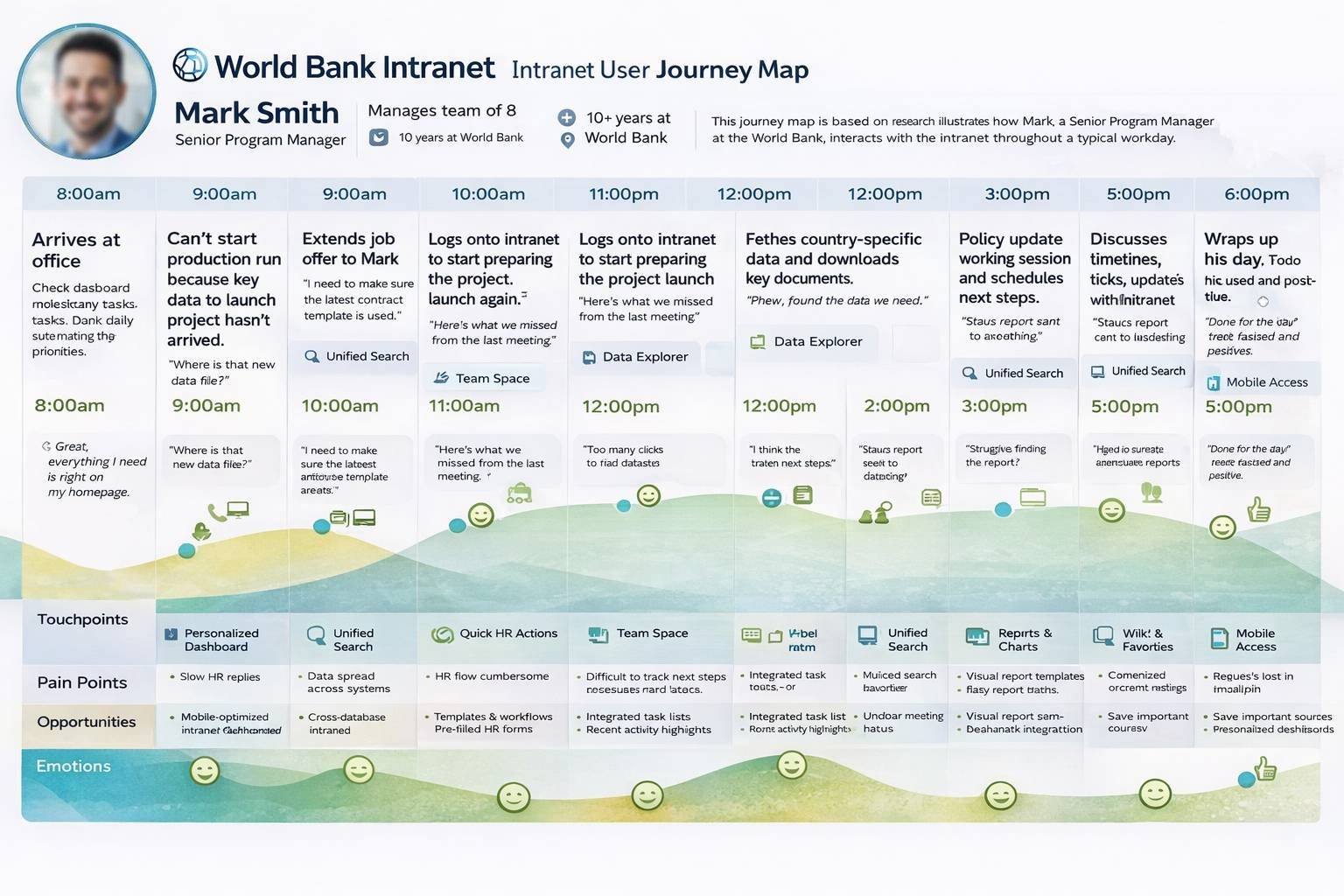
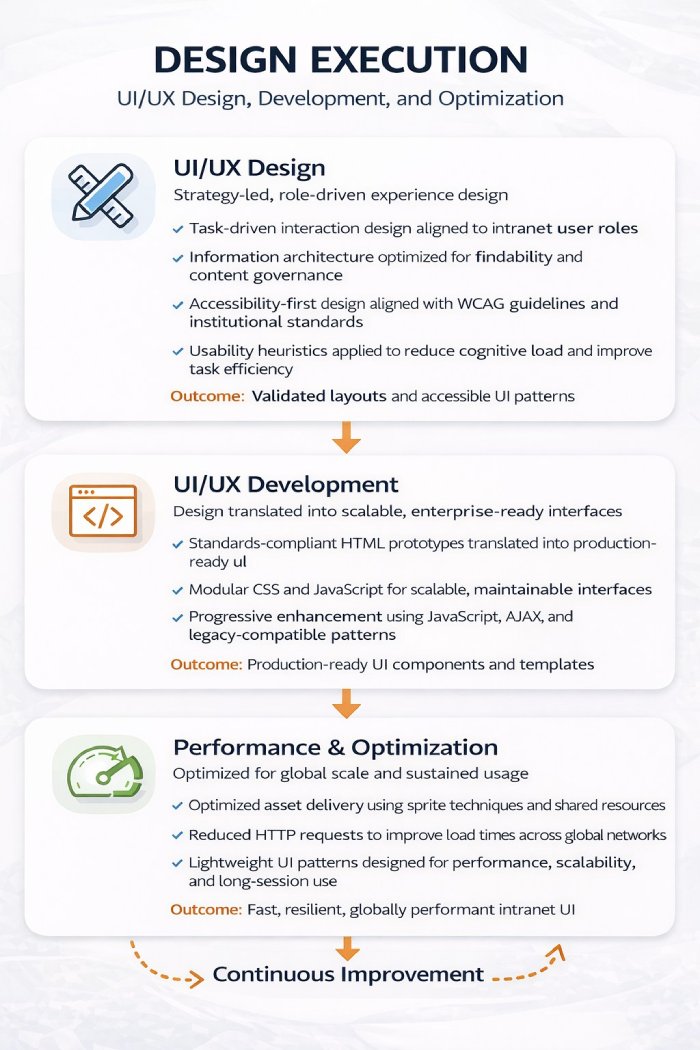
DESIGN EXECUTION
UI/UX Design
- Task-driven interaction design aligned to intranet user roles
- Information architecture optimized for findability and content governance
- Accessibility-first design aligned with WCAG guidelines and institutional standards
- Usability heuristics applied to reduce cognitive load and improve task efficiency
UI/UX Development
- Standards-compliant HTML prototypes translated into production-ready code
- Modular CSS and JavaScript for scalable, maintainable interfaces
- Progressive enhancement using JavaScript, AJAX, and legacy-compatible patterns
- UI customization and theming for enterprise platforms such as Liferay and SharePoint
Performance & Optimization
- Optimized asset delivery using sprite techniques and shared resources
- Reduced HTTP requests to improve load times across global networks
- Lightweight UI patterns designed for performance, scalability, and long-session use
SITE MAP
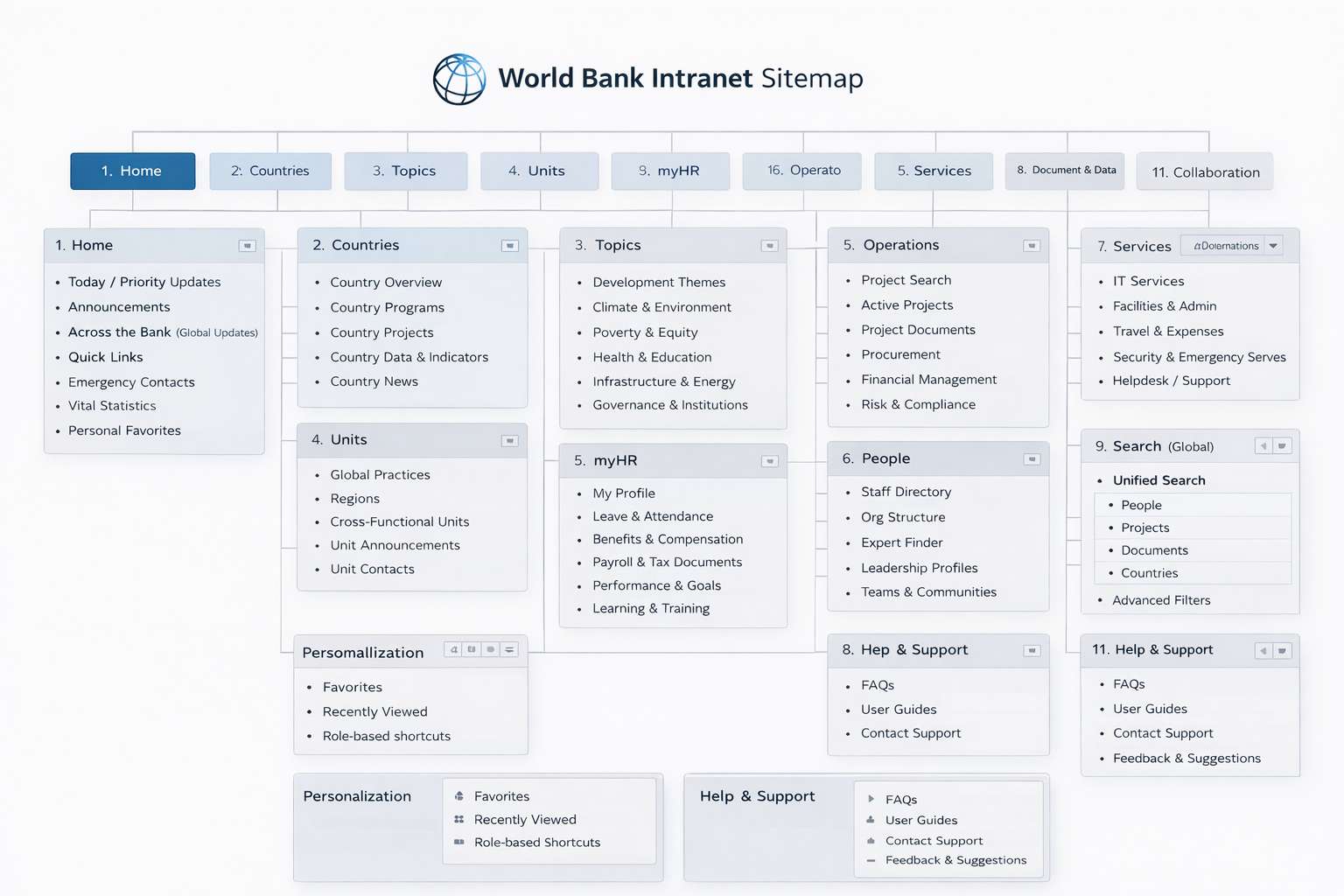
The next phase focused on developing the intranet site map. The initial structure was highly complex, with numerous services, sections, and overlapping content areas. The objective was to rationalize this structure—reducing unnecessary complexity while ensuring that all critical information remained accessible. The resulting site map prioritizes clarity, findability, and task efficiency, enabling users to locate relevant content quickly without navigating excessive layers.
PAPER PROTOTYPING
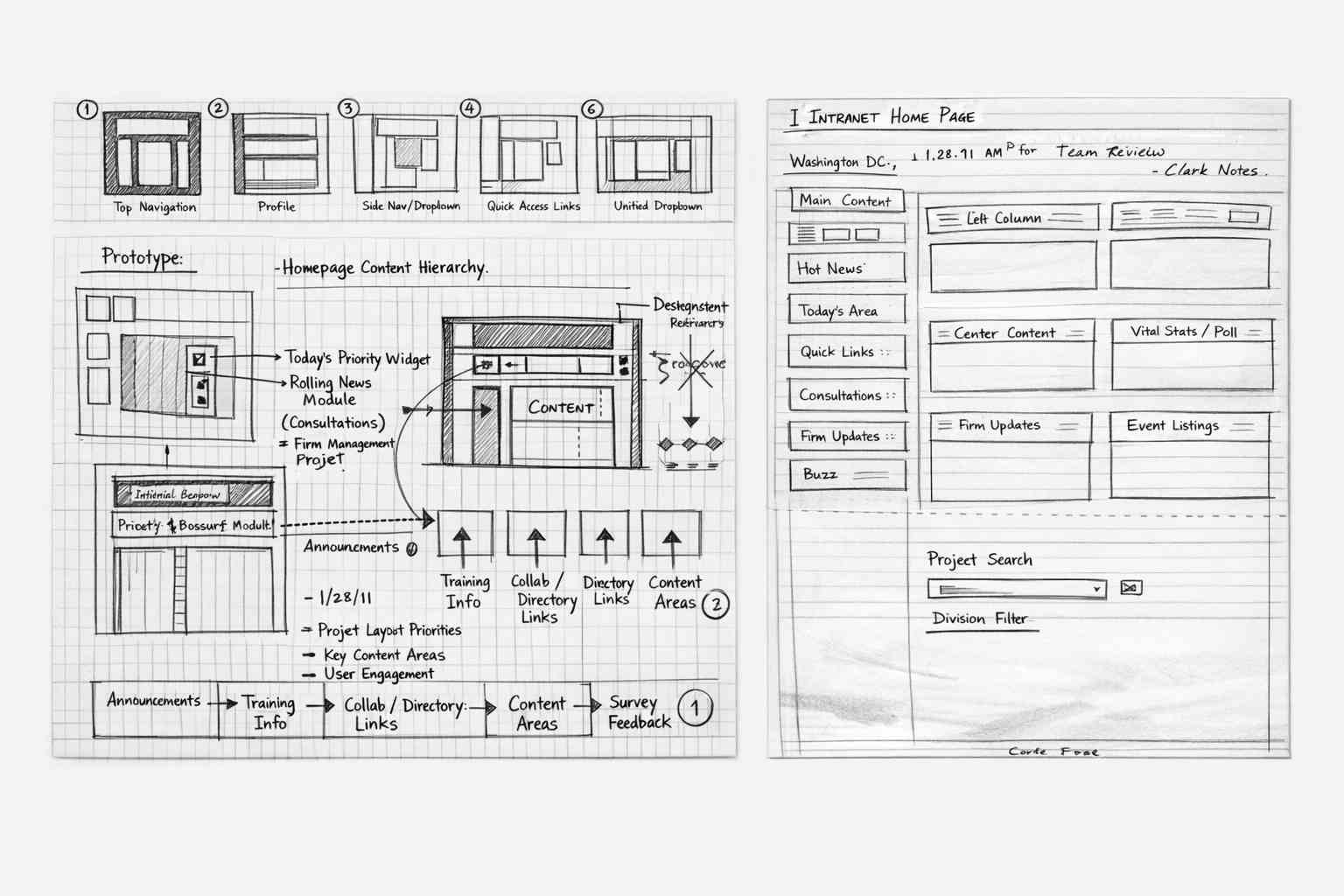
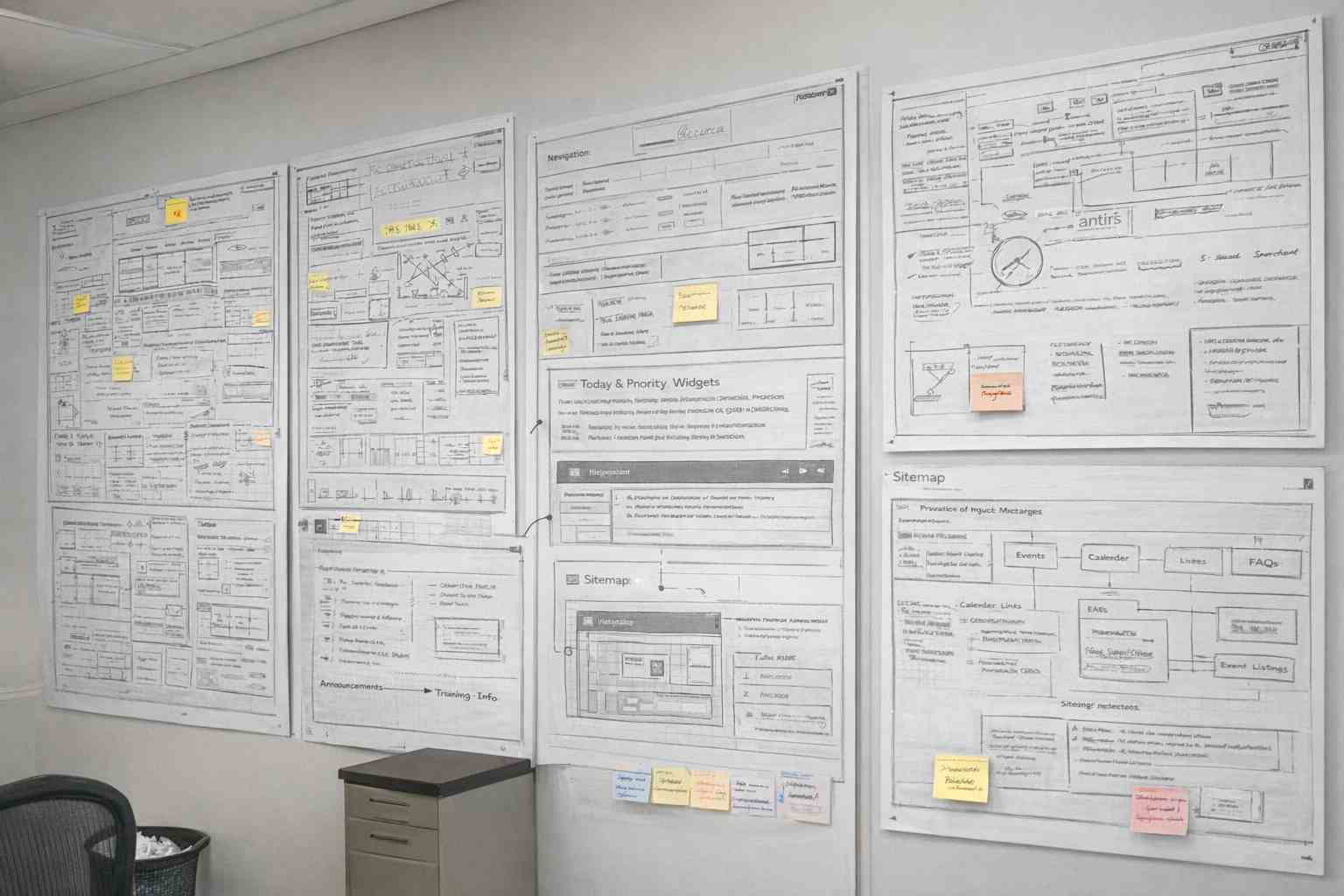
I explored multiple layout options to define how information on the intranet homepage could be structured and prioritized. These concepts were reviewed and consolidated into a single, refined layout that best supported key user tasks and content hierarchy. In parallel, the design was evaluated across different screen sizes to ensure a responsive experience that remains effective across devices commonly used within the organization.
Wireframes were used as a primary tool to rapidly explore and validate alternative structural approaches before progressing to detailed design.
DETAIL WIREFRAMING
During this phase, Figma was used to create detailed digital wireframes for all key intranet pages. These wireframes were then connected into a cohesive and consistent structural flow, defining clear relationships between pages, components, and user actions.
The objective of this step was to illustrate how content, navigation, and functional elements interact across the intranet, ensuring a seamless and predictable user experience before advancing to high-fidelity design and development.
HIGHFIDILITY PROTOTYPING
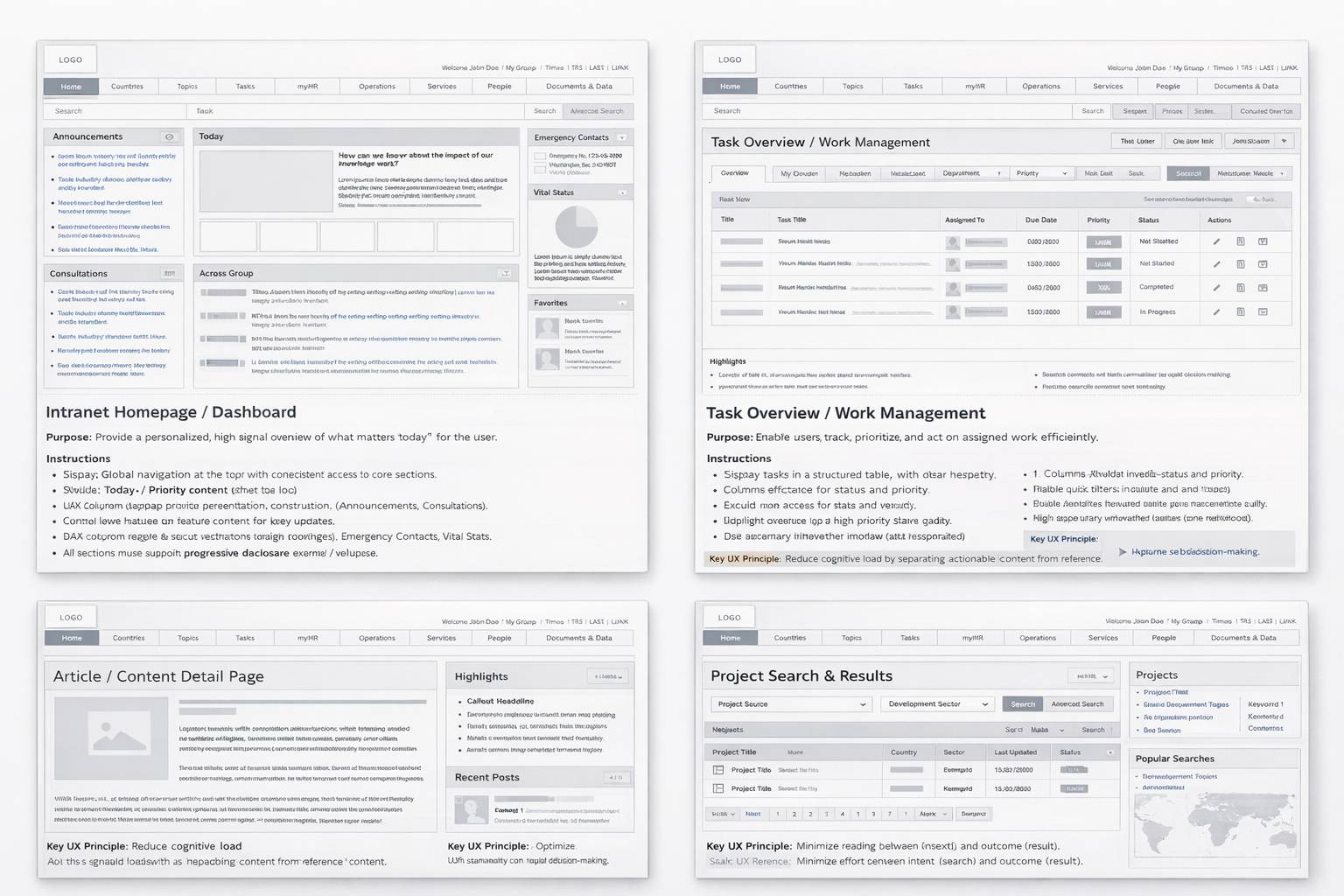
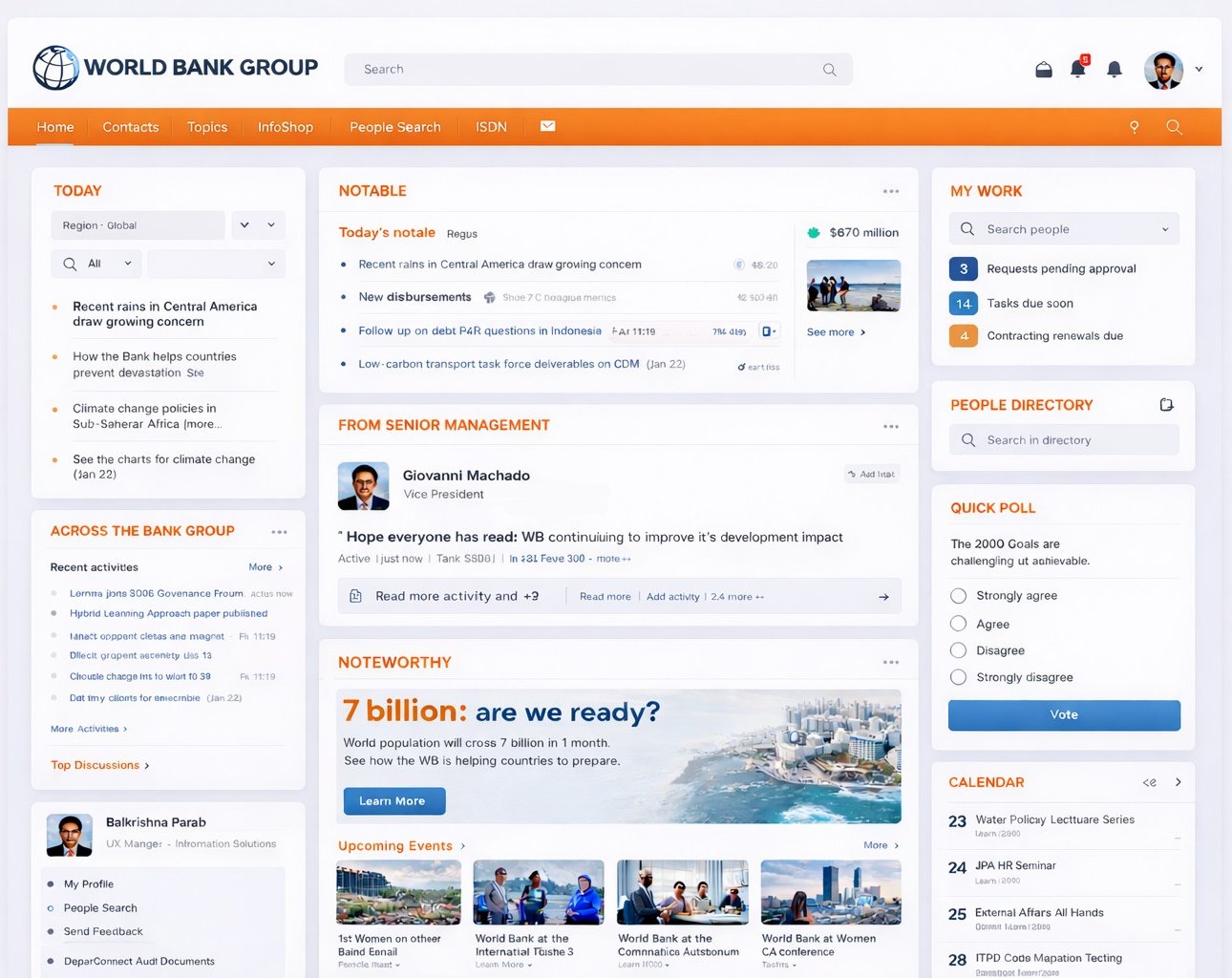
High-fidelity prototypes were developed to translate validated wireframes into a realistic, interactive representation of the World Bank intranet experience. These prototypes incorporated final layout structures, visual hierarchy, typography, color usage, and component behavior aligned with established brand and accessibility standards.
The prototypes were designed to simulate real user interactions, including navigation flows, content discovery, and key task completion paths. This enabled stakeholders and delivery teams to review the experience in context, validate usability and accessibility considerations, and identify refinements prior to development. The high-fidelity prototype served as a shared reference point for design validation, stakeholder alignment, and efficient handoff to engineering teams.
USABILITY STUDY
Usability studies were conducted using an unmoderated approach, allowing participants to independently interact with the prototype while completing representative tasks. Participants provided feedback through structured questions and observational inputs, highlighting areas of clarity, confusion, and friction within the experience.
The collected data was analyzed and synthesized to identify recurring patterns, usability issues, and behavioral trends. These insights informed targeted design refinements, ensuring that key pain points were addressed early in the process.
The primary objective of this study was to uncover usability barriers and workflow inefficiencies prior to final implementation, reducing risk and improving overall usability before the intranet experience was rolled out more broadly.
The usability study produced prioritized findings and actionable insights that identified usability issues, validated task flows, and informed targeted design improvements. These outcomes reduced implementation risk and ensured a more efficient, user-friendly intranet experience prior to launch.
- Identified key usability issues affecting task completion
- Prioritized findings based on impact and severity
- Validated navigation and core user workflows
- Informed targeted design refinements before development
- Reduced usability risk prior to intranet rollout
Business Benefits
- Cost savings through offshore delivery
- Access to scalable UX talent
- Improved turnaround times
- Better utilization of internal teams
- Improved intranet user experience
Outcomes
The UXM initiative successfully standardized interaction patterns, improved performance, and established a sustainable UX operating model for the World Bank’s intranet ecosystem.
The final intranet experience evolved iteratively through user feedback, resulting in improved homepage and inner page designs that aligned usability, performance, and enterprise requirements.